Enhance your daily nutrition with Vitamin and Minerals
Micronutrients are essential for normal growth, development, and physiological function. Both vitamins and minerals are required in small amounts for metabolism, immune function, and health.

Overview
Vitamins and minerals are essential nutrients that support nearly every function in the body—from energy production and immune defense to bone strength, brain function, and hormone balance. While a balanced diet is the foundation of good health, modern lifestyles, dietary restrictions, and individual needs can make it difficult to consistently meet all nutritional requirements through food alone.
This page is designed to help you understand what each vitamin and mineral does, who may benefit from supplementation, and how to use them safely and effectively. Instead of overwhelming you with technical language, we focus on clear explanations, practical guidance, and research-informed insights—so you can make decisions that fit your life.
How to navigate
-
Browse vitamins and minerals by tabs
-
Learn what each nutrient does and why it matters
-
Explore usage guidance, suitability, and safety notes
-
Access research references if you want to go deeper
*Disclaimer: This page is for learning and clarity, not medical diagnosis

Vitamin and Minerals
Overview
Vitamins and minerals are essential nutrients that support nearly every function in the body—from energy production and immune defense to bone strength, brain function, and hormone balance. While a balanced diet is the foundation of good health, modern lifestyles, dietary restrictions, and individual needs can make it difficult to consistently meet all nutritional requirements through food alone.
This page is designed to help you understand what each vitamin and mineral does, who may benefit from supplementation, and how to use them safely and effectively. Instead of overwhelming you with technical language, we focus on clear explanations, practical guidance, and research-informed insights—so you can make decisions that fit your life.

-
Browse vitamins information by tabs
-
Learn what each nutrient does and why it matters
-
Explore usage guidance, suitability, and safety notes
-
Access research references if you want to go deeper
Vitamin
Vitamin A

Vitamin A is a fat-soluble vitamin that exists in two main forms
When considering a supplement : Supplementation may be useful when dietary intake is insufficient, but moderation is essential.
Vitamin A has two main forms:
1. Preformed vitamin A (retinol, retinal, retinoic acid) — from animal sources
2/ Provitamin A carotenoids (e.g. beta-carotene) — from plant sources.
The body converts beta-carotene into active vitamin A as needed.
It plays a key role in maintaining healthy tissues and supporting the body’s natural defense systems.
Vitamin A has two main forms:
1. Preformed vitamin A (retinol, retinal, retinoic acid) — from animal sources
2/ Provitamin A carotenoids (e.g. beta-carotene) — from plant sources.
The body converts beta-carotene into active vitamin A as needed.
It plays a key role in maintaining healthy tissues and supporting the body’s natural defense systems.
-
People with limited intake of animal products
-
Individuals with absorption issues
-
Those concerned about skin or eye health
-
Vitamin A is fat-soluble, so it’s best taken with meals that contain healthy fats. It is usually taken once daily. Vitamin A should be used carefully. Excessive intake over time may lead to toxicity, especially from retinol forms rather than beta-carotene.
-
RDA (adults): ~700–900 µg RAE/day
-
Upper limit: 3,000 µg retinol/day
Beta-carotene is generally safer than preformed retinol at higher intakes.
-
Chronic excess retinol can cause toxicity High doses contraindicated in pregnancy • Fat-soluble → accumulates in the body • Not recommended in high doses during pregnancy
• Avoid combining multiple vitamin A products unless advised
Liver, egg yolk, dairy (retinol)
Carrots, sweet potatoes, spinach
(beta-carotene)
NIH Office of Dietary Supplements (ODS): Vitamin A Fact Sheet • WHO: Vitamin A deficiency and supplementation • EFSA: Dietary Reference Values for Vitamin A


-
Browse information by tabs
-
Learn what each nutrient does and why it matters
-
Explore usage guidance, suitability, and safety notes
-
Access research references if you want to go deeper
Minerals
Magnesium
.png)
Magnesium is an essential mineral involved in over 300 enzymatic reactions in the body. It plays a central role in energy production, muscle and nerve function, and nervous system regulation.
Magnesium is not stored in large amounts, and dietary intake is often below recommended levels in modern diets.
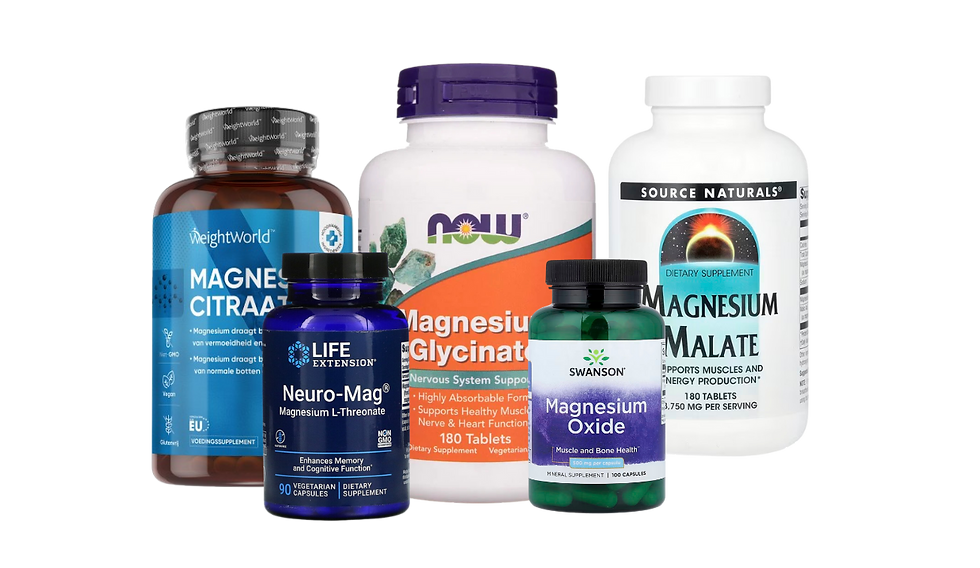
Different forms serve different purposes:
-
Magnesium Citrate
Well-absorbed; commonly used for general supplementation and digestive support. -
Magnesium Glycinate
Bound to glycine; gentle on digestion, often used for stress, sleep, and muscle relaxation. -
Magnesium Oxide
High elemental magnesium but lower absorption; often used for digestive purposes. -
Magnesium Threonate
Crosses the blood–brain barrier; studied for cognitive support. -
Magnesium Malate
Bound to malic acid; often used for energy and muscle support.
-
Magnesium supports:
-
Energy production (ATP activation)
-
Muscle contraction and relaxation
-
Nerve signaling
-
Stress response and sleep regulation
-
Bone health and mineral balance
-
Blood sugar and insulin si
-
-
People with limited intake of animal products
-
Individuals with absorption issues
-
Those concerned about skin or eye health
-
Vitamin A is fat-soluble, so it’s best taken with meals that contain healthy fats. It is usually taken once daily. Vitamin A should be used carefully. Excessive intake over time may lead to toxicity, especially from retinol forms rather than beta-carotene.
-
RDA (adults): ~700–900 µg RAE/day
-
Upper limit: 3,000 µg retinol/day
Beta-carotene is generally safer than preformed retinol at higher intakes.
-
Chronic excess retinol can cause toxicity High doses contraindicated in pregnancy • Fat-soluble → accumulates in the body • Not recommended in high doses during pregnancy
• Avoid combining multiple vitamin A products unless advised
Liver, egg yolk, dairy (retinol)
Carrots, sweet potatoes, spinach
(beta-carotene)
NIH Office of Dietary Supplements (ODS): Vitamin A Fact Sheet • WHO: Vitamin A deficiency and supplementation • EFSA: Dietary Reference Values for Vitamin A


.png)

Shop Popular Products

_edited.jpg)

Research & Information Sources
All educational content on BetterHealthWay is informed by publicly available research, consensus statements, and health guidance from the following reputable organizations and institutions.







Recent Blogs



Vitamin Supplements


Vitamin A
Vitamin A is a fat-soluble vitamin that exists in two main forms:
Preformed vitamin A (retinol, retinal, retinoic acid) — from animal sources
Provitamin A carotenoids (e.g. beta-carotene) — from plant sources
The body converts beta-carotene into active vitamin A as needed. It plays a key role in maintaining healthy tissues and supporting the body’s natural defense systems.
Source of vitamin A: Liver, egg yolk, dairy (retinol), carrots, sweet potatos, spinach (beta carotene)

Vitamin A supports:
• Normal vision, especially in low-light conditions via retinal • Immune system function
• Skin and epithelial tissue health
• Cell growth and differentiation Retinoic acid acts directly on nuclear receptors, influencing gene transcription.
Supplementation may be useful when dietary intake is insufficient, but moderation is essential.
Intended users • People with limited intake of animal products • Individuals with absorption issues • Those concerned about skin or eye health Usage direction and dosage Vitamin A is fat-soluble, so it’s best taken with meals that contain healthy fats. It is usually taken once daily.
• RDA (adults): ~700–900 µg RAE/day • Upper limit: 3,000 µg retinol/day Beta-carotene is generally safer than preformed retinol at higher intakes.
Chronic excess retinol can cause toxicity
Vitamin A should be used carefully. Excessive intake over time may lead to toxicity, especially from retinol forms rather than beta-carotene.
• Fat-soluble → accumulates in the body • Not recommended in high doses during pregnancy
• Avoid combining multiple vitamin A products unless advised
NIH Office of Dietary Supplements (ODS): Vitamin A Fact Sheet • WHO: Vitamin A deficiency and supplementation • EFSA: Dietary Reference Values for Vitamin A
Minerals
.png)
Magnesium
Magnesium is an essential mineral involved in over 300 enzymatic reactions in the body. It plays a central role in energy production, muscle and nerve function, and nervous system regulation.
Magnesium is not stored in large amounts, and dietary intake is often below recommended levels in modern diets.

Dietary Sources
-
Leafy green vegetables
-
Nuts and seeds
-
Whole grains
-
Legumes
-
Magnesium supports:
-
Energy production (ATP activation)
-
Muscle contraction and relaxation
-
Nerve signaling
-
Stress response and sleep regulation
-
Bone health and mineral balance
-
Blood sugar and insulin signaling
-

Magnesium Citrate
Well-absorbed; commonly used for general supplementation and digestive support.

Magnesium Citrate
Well-absorbed; commonly used for general supplementation and digestive support.
Magnesium Citrate
Well-absorbed; commonly used for general supplementation and digestive support.
Magnesium Citrate
Well-absorbed; commonly used for general supplementation and digestive support.
Magnesium Citrate
Well-absorbed; commonly used for general supplementation and digestive support.
Supplementation may be helpful when dietary intake is low or during periods of stress, intense physical activity, or muscle tension.
Intended Users
Active individuals and athletes
People experiencing muscle cramps or tension
Those under chronic stress Individuals with low dietary magnesium intake
Usage Direction and Dosage
Magnesium is typically taken once daily, often in the evening.
RDA (adults): ~310–420 mg/day (varies by sex and age)
Higher doses may be divided to improve tolerance
-
Excess intake may cause diarrhea
-
Individuals with kidney disease should consult a professional
-
Different forms have different tolerability
-
-
NIH Office of Dietary Supplements (ODS): Magnesium Fact Sheet
-
NCBI: Magnesium in cellular energy metabolism
-
Harvard T.H. Chan School of Public Health: Magnesium overview
-

Research Sources
Relevant Blogs


Contact Info
BetterHealthGuide
© 2026 by Better Health Guide
Proudly designed by Nguyet Anh Bui